

The Basics of Electricity: A Novice Guide to Electrical Principles and Terminology

Photo above by João Camargo
By Naveen Devinda and D. A. Cullors (Contributing Authors)
Electricity has been a revolutionary discovery for mankind and was developed through literally shocking experiences of several scientists over hundreds of years. It is fascinating how electricity can kickstart someone’s heart while also possibly frying someone up. Today, electrical energy is the form of energy that’s most commonly used around the world. Personal devices, appliances, vehicles, machinery, medical equipment, etc. all use electrical energy to function. Nevertheless, the generation, storage, and transmission of electricity are complicated processes, and we are still advancing towards more efficient and sustainable methods. This article will discuss the fundamentals of electricity, how these principles trickle down to the electronics that we use on a day-to-day basis, and what some of the present-day challenges are.
Fundamentals of Electricity
Have any of these questions crossed your mind?
- How come certain home appliances like the fridge, TV, vacuum cleaner, etc. plug directly into the wall sockets, yet your laptop and phone chargers come with a “brick” or “adapter” in the cable?
- Why couldn’t we just have a single charger/adapter for our phone, laptop, and other devices?
- Why do I use AA batteries for my remote control, and Li-ion batteries on my phone?
- I connected an LED to a battery, and it got fried. Why??
The reasons for the above, and the majority of other electronics questions, are the three primary characteristics of electricity: voltage, current, and resistance. The definitions of these terms can only do so much to present the idea to a beginner. An analogy between electricity and the behavior of water supply systems, which everyone can fathom, is a better way to deliver the concepts.
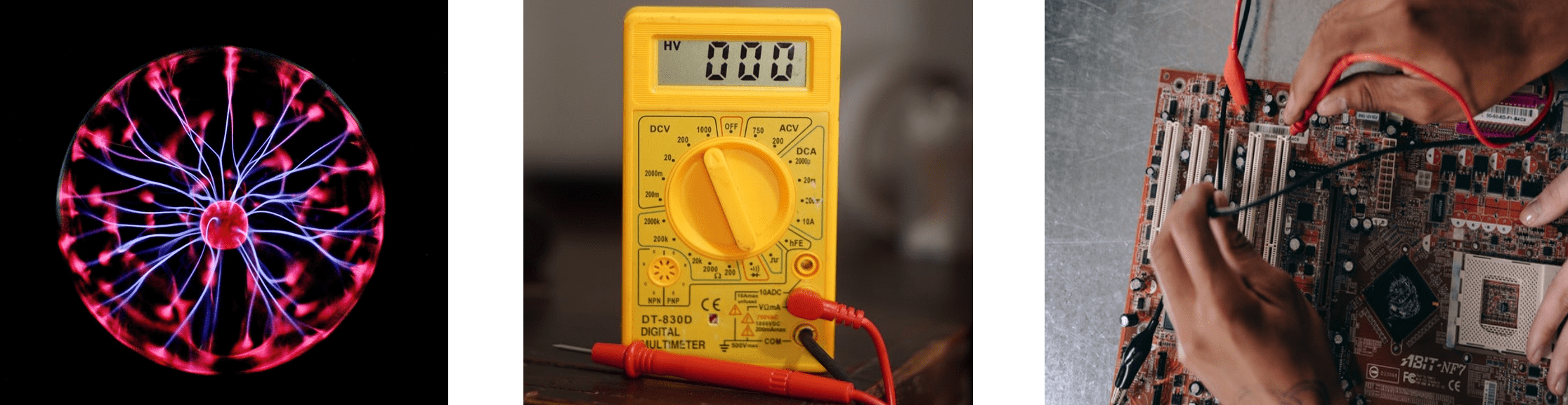
Current – It’s like the flow of water along a pipe, but here instead of water it’s electrons that flow, and the conductor (i.e., the wiring, etc.) would be the medium.
Voltage – Water flows from a higher-pressure area to lower-pressure. A river starts at a mountain and flows downstream until it hits sea level, and never the other way around. That’s why water suppliers need to use motors to pump water (create high pressure) to ensure users at altitudes higher than their distribution center get water. Think of voltage as the pressure difference that allows current to flow.
Resistance – Imagine a faucet in your home, you can control the water flow by adjusting the lever. You are essentially restricting the flow by adding resistance to the pathway. With larger water loads a lot of resistance can cause stress on pipes, joints, and other locations which eventually give in to fractures and failures. Electrical resistance works similarly and tells us how easily a current can flow across a conductor. Instead of fracturing, when conductors can’t handle the current, they give off heat, and finally, warp or melt. Resistance is what causes your devices to heat up, it’s also what makes your electric kettles, irons, and water heaters work.
The Grid
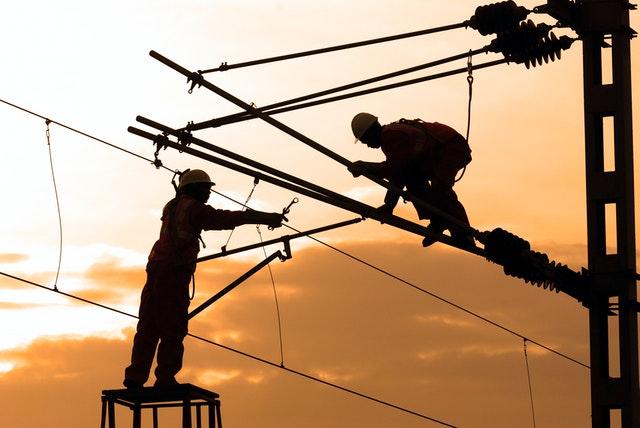
Unlike water, we can’t collect electricity in and of itself from our environment (unless of course, we could literally catch lightning in a bottle). We have to generate electrical energy by converting other forms of energy like chemicals (fossil fuels like coal, natural gas, etc.), solar, and gravitational energy (dams and tides). The output of several power stations is combined within a network known as a grid, from which electricity gets distributed across cables to consumers like you and me.
As a consumer, it’s important to know how we get charged by our electricity service providers. The billing system charges you for the energy you consume for a given period (usually a month). Here’s where the power ratings of our electronic devices come into play. The power rating of a device, given in Watts, tells us how much energy it consumes every second.
Let’s consider the following devices:
- CFL Light Bulb – 30 W
- Electric Water Heater – 3600 W
- Laptop – 70 W
- Washing Machine – 300 W
If you continuously use all 4 devices for an hour, you’d have used a total of 4000 Watt-hours. Every 1000 Watt-hour is a kilowatt-hour aka a “unit”. Your billing company is going to charge you based on how many units you’ve accumulated at the end of each month.
So how many units did your household use last month? Which device do you think contributed the most?
Challenges of the present-day
We’ve achieved so many feats from just being able to replace gas lamps to now where not many of us can imagine a life without electricity. The electricity and electronics industry is far from being a perfect model and engineers and scientists are striving to overcome the challenges they continue to pose. These challenges can be classified under 3 main categories: sustainability, equity, and efficiency.
-
Sustainability
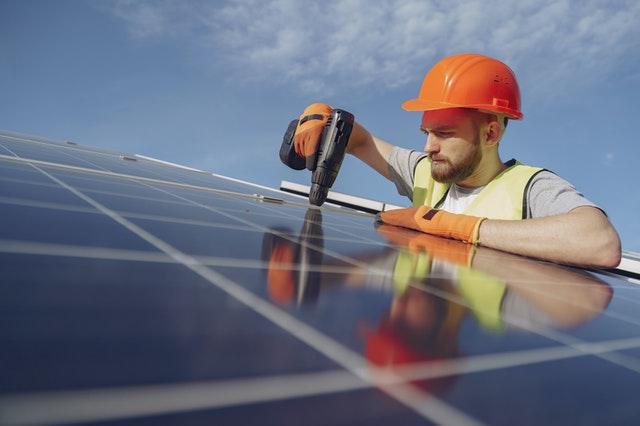
Are e-bikes and electric cars eco-friendly? What about so-called, green-constructed buildings? On the surface, yes, they may minimize fuel emissions in some ways, but we have to also ask- how was the electricity generated and used to produce or power the building, e-bike, or car to begin with? An electric vehicle that is recharged at night using the owner’s home electricity is still likely using non-renewable energy to get recharged. Similarly, a “green” building that has a mostly glass exterior will likely heat up more, and quicker, than one using less glass- which means it will also require more energy to keep cool than the alternatives. Unless this building can generate all of its needed power from a renewable source it will also end up having to tap into non-green sources of power. According to the US Energy Information Administration, over 60% of the electricity in the US was generated by burning fossil fuels in 2020. And as the demand for electricity increases rapidly so will our carbon footprint on the environment. We need to ensure we use sustainable options and look out for clean alternate sources that can help meet the demand.
-
Equity

In developed countries, electricity is a need that follows in line with food and water. But, as of the writing of this article, statistics from “Our World in Data” shows that over 750 million people do not have access to electricity globally. There are various reasons like not being able to afford basic infrastructure, geographical location, and lack of resources. Even though these numbers keep dropping over the years, innovation and technology will play a critical role in establishing energy equity.
-
Materials and efficiency
As we discussed earlier, heat is a major contributor to energy loss. To put this into perspective we are losing 8-15% of energy as heat between the power plant and the consumers. Scientists are looking for ways to come up with new materials that have minimal resistance while being cost-effective to adopt on an industrial scale. Superconductors (metals with practically 0 resistance) have been the buzz since the early 1980s, but we are still far from reaching practical applications. Nonetheless, scientists are making leaps by the day and the future of electricity is certainly promising.











Responses