

How to teach without creating confusion.


If you know something, you can teach it- right? Well, not necessarily, as it turns out. Getting someone else to know what you know is a totally different ballgame….and it’s even more complicated when there are a whole bunch of ‘someone else’s. But be patient, it took you time, probably a lot of time, to learn your subject well enough to even qualify to teach it, so why shouldn’t it take at least some time to get good at that?
In the age of information abundance your main value as an instructor is more in the filtering, simplification, personalization, rigor, and feedback you provide than it is in being a gatekeeper of knowledge as was previously the case. When you teach a group of people who all have different levels of ability, understanding, or interest in your topic you have to anticipate a lot- chief of all, the range of potential pitfalls and misunderstandings that might ensue. I've included some tips that I have found helpful from my own experience and study. There is a wealth of literature about teaching methodology, and I encourage you to always do more research. In the meantime, I'll try to digest some of it and present it to you here and in future blogs. If you’re a new or struggling teacher, try to incorporate these tips little by little. I’ll divide them into different blogs where I’ll cover topics like:
The foundation of most of these tips involves having a sense of what your audience can and cannot digest. Much of what I will say has the novice learner in mind, so these tips can absolutely be bent or broken depending on what or whom you are teaching. Use your own discretion with implementing them. Each student, each class period, and each course is different. On top of this, there are ebbs and flows throughout the year that affect student receptivity and productivity. Be willing to adjust.
Lastly, I will generally use examples from my own subject, Spanish, however, I encourage you to think of examples of how each tip could apply to yours. Share your ideas in the comments below.
1. Focus on what's most useful and practical first.
Useful and practical will always seem more relevant to learners. It also makes the topic more relatable and gives the learner a way to personalize the lesson for themselves. At the beginning of learning a new skill you need the student to have that "I can do this," or, "I can use this," feeling. We all want that feeling of accomplishment, or at least the sense that there’s the possibility of accomplishment. Not only do we want to know that we can do a thing, but also that the thing is likely to need to be done to begin with- in other words, that it has a practical use. Of course, what’s considered useful or practical will vary from subject to subject.
Example
- In my Spanish class, this means starting the year with high-frequency words and phrases before less common phrases.
- These are words like the ones I call my "Big 5”: quiero (I want), necesito (I need), voy a (I’m going to), puedo (I can), tengo/ tengo que (I have/ I have to). There are PLENTY of times where you might want or need to use these words- so learning them would seem obviously important.
- Or, similarly, an English language learner might do better to focus on words like hard and difficult, rather than strenuous and arduous since they are more likely to encounter the first two than the last two.
2. If you're introducing new concepts, focus on only one at a time.
The phrase “at a time” can mean one concept per day or may simply mean one concept at the moment. Remember, whatever you are talking about, the student has to think about. So make sure your overall focus, as well as your main points, are clear and concise. When the subject or skill is new, don't overload the brain with too much to figure out. This doesn’t mean to go artificially or excessively slow of course.
Example
- In Spanish, I generally add one new grammar or proficiency topic per day- while using familiar vocabulary to practice it, or, I may use familiar topics to help introduce new vocabulary. However, I would only introduce new grammar AND new vocabulary at the same time if I were confident the students could handle both.
3. Teach easier concepts before more difficult ones. Especially if the easier ones can simplify the difficult ones.
One of my former Math professors once said, “If you can add, subtract, multiply, and divide you can do any kind of math.” The converse is true too, if you struggle with adding, subtracting, multiplying, and dividing, you won't be able to do other levels of math. I remember hearing a former principal and mentor of mine say, “Sometimes when kids act up, it’s because your class is either too easy, or it’s too hard.” Each of us has been on one extreme or the other, but it’s easier to end up on the “too hard” end of the spectrum than you might think. Sometimes we are in such a hurry to get into the deep and complex parts of our subject (the good stuff) that we skip the critical steps that build towards that level properly. This tip simply helps to keep interest or provide motivation to continue when the learning does get harder.
Example
- In foreign language classes this may mean grading novice students more on vocabulary acquisition than elaborate conversational skill, or grammatical purity. Or teaching cognates (words that are similar in two different languages like situación, posición, diferente, importante), before bothering with words that look nothing like English- like oigo, or esternocleidooccipitomastoideo.
- Similarly, in Math this may mean practicing the fundamentals (adding, subtracting, multiplying, and dividing) before scaling up to Trigonometry or Calculus.
By the way, this step can also be a warning not to over-complicate your explanations- even the ones for simple concepts. You’d be surprised how easily a basic topic can be made confusing simply by overly explaining it. No, I’m not asking you to hang out in easy territory forever and never challenge your learners- that can get boring and problematic as well. This is a tip that can certainly be bent or broken. There are occasionally some topics, or levels of topics, where starting with the more challenging level first provides a better framework for learning the material in general or creates the right sense of urgency. If you teach an upper-level or advanced class, for instance.
4. Use positive and negative examples.
You rarely remember 100% of anything, even when you understand it well- therefore you almost certainly won’t remember something you don’t understand at all. So, getting to that “I understand” moment is a necessary key, even if it alone isn't sufficient. To help with this use analogies and opposite analogies to help students conceptualize from multiple angles. With these, you show your students what something is like, or not like, to create a juxtaposition. Analogies require and coach the student to find the commonality or patterns in related material so they can make inferences and draw conclusions on their own when they encounter the same information in different forms or circumstances.
- Spanish verbs change a lot at the end. As opposed to modern-day English where the end doesn’t change very much.
I do, You do, He / She does
I did, You did, He / She did
- But, if you’ve ever read Shakespeare, or a 1611 KJV Bible, you’ve already seen English verbs do this quite a lot actually.
I do, Thou doest, He / She doeth
I did, Thou didest, He / She dideth
- In modern English it’s what you add in front of a word that shows who’s doing (or did) something, but in Spanish it’s how you change the ending that does this- a little more akin to older English. For Spanish, adding a word in front is largely unnecessary.
Hago, Haces, Hace
Hice, Hiciste, Hizo
The first list is the negative example, or opposite analogy- showing how Spanish will be unlike English. The second example is the positive example, or analogy- showing how Spanish is like English in at least some way. Now, using analogies isn’t going to make you remember the material per se, but it does make the material more approachable and relatable- which can help clear the way for its memory.
Another example worth mentioning is that charts can setup analogies as well. For instance, using the chart below, answer the following questions.- If to speak is hablar, and I speak is hablo; how would you say I use?
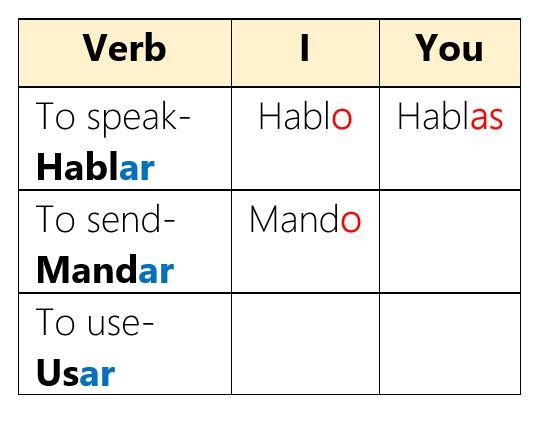
- Hopefully you guessed: uso, mandas, and usas.
5. Separate similar concepts to avoid confusion.
There is a mistake and also a problem in each of the following scenarios:- Justine has just learned that when a verb ends with an -o it refers to I…and correctly understands that digo means I say. But, she is then shown a sentence with the word dijo and wrongly thinks it means I said, or something like that.
- Ca’myron has just learned that lo means it… and correctly understands that lo recomiendo means I recommend it. But, he is then shown a sentence with lo recommendable and wrongly thinks it means It is recommendable.
- Alena has just learned that soy and estoy mean I am. But, then incorrectly translates I am tall, and I am angry as Estoy alto, and Soy enojado.
The mistake in each of these situations is that the novice students couldn’t differentiate between two things that were too alike. The problem is that the teacher likely contributed to the situation by combining similar, but differing concepts, and thereby creating unintended confusion.
Let’s look at it this way, using the Spanish words digo, practico, produjo, veo, hablo, estuvo, and vio. If I had taught you that the -o ending in Spanish referred to I, and later told you that a few of the words above actually refer to he or she- would you have been able to tell me which? The answer is produjo, estuvo, and vio. As with the three examples above, unless you are a native Speaker or an intermediate learner you wouldn't have been able to tell me the correct answer, because there isn't anything obviously different in each instance that would allow you to differentiate right from wrong. Making things worse, produjo, estuvo, and vio are actually irregular verbs, and so it's basically pure happenstance that they have the same ending as verbs that refer to I. Thus, there isn't even a pattern about them that a novice could've relied upon to avoid the mistake. Knowing this, I would never have presented material mixed in this way to you in the first place. Only after one concept was firmly established would I show the other.
Yes, I know what some of you are saying, "But, but....in the real-world information isn't always going to be tiered or simplified!" And that's true, but that's also pretty much THE very reason we invented school to begin with- because without a safe place where concepts could be broken down, paced, and tiered, people would be much more poorly equipped to understand and make use of such information in the real world.
This tip, probably more than any other, requires you to put yourself in your learner’s position. We instructors are experts. We have degrees, certifications, years of experience, and sometimes a natural inclination toward the information we teach- and so we sometimes forget, or underestimate, how difficult our subjects are to those who don’t have any of this. Therefore, we sometimes revel in the theoretical and philosophical, lump skills or topics together, spend too little time building foundational knowledge, and give inadequate explanations, only to then expect the learner to “just know” how to filter everything into the proper place. We have to respect the fact that there are always potential points of confusion for a learner, and a novice, or careless, instructor could certainly further complicate the situation if they can’t or won’t anticipate these points.
Summary of tips:
- Focus on what's most useful and practical first. Don't begin with information that has a low chance of being used or relevant.
- If you're introducing new concepts, focus on only one at a time. Don't bombard your audience with too much new info and expect them to filter or retain it.
- Teach easier concepts before more difficult ones. Don't lead off with things you haven't done anything to help the audience understand before.
- Use positive and negative examples. Don't assume one basic example is always going to be enough to paint the picture for someone who has little-to-no prior understanding.
- Separate similar concepts to avoid confusion. Don't mix potentially confusing elements into your lesson. If there are exceptions to what you're teaching, either give the audience a way to easily tell the difference between the exception and the rule- or just leave the exceptions for a later date.
"Michel Thomas Method: The Learning Revolution." by Jonathan Solity.
"Make It Stick." by Peter C. Brown, Henry L. Roediger III, and Mark A. McDaniel.
"Tools For Teaching: Discipline, Instruction, and Motivation." by Fred H. Jones and Patrick Jones










Responses