

How to Create and Solve Linear Equations: A Step by Step Guide to Mastery


Photo by Yan Krukov from Pexels
By Naveen Devinda and D. A. Cullors (Contributing Authors)
A “linear equation” is one of the elementary concepts that you are going to come across when studying Algebra. Before diving into the computations and methods used to solve these equations, it is useful to have a clear understanding of what an “equation” is and what makes it “linear”. In this article, we will use the term “equation” and “relationship” interchangeably because they essentially give out the same idea.
An equation can be thought of as a mathematical interpretation of a relationship between one or more items. “Items” might seem like a vague term, but it portrays the idea that it literally could refer to anything. The sooner learners ingrain this concept the sooner they develop their application and problem-solving skills. A few examples would look like this:
1. Tom is 20 years younger than his father: T = F – 20
2. The reaction towards an event leads to an outcome: Event + Reaction = Outcome. (see “Emotion equation by Chip Conley”)
3. How the lengths of the three sides a, b, and c of a right-angled triangle related: a² = b² + c²
4. The relationship between my weight, the calories I take in, and the calories I expend: My weight tomorrow = My weight today + Calories in food – Calories burnt through Exercise.
Linear equations are the simplest form of equations. A linear equation is an equation where the highest power of all the variables is 1. In other words, no exponents would be higher than 1. If you see an exponent of 2 or higher it is not a linear equation. Could you identify which of the above relationships are linear? The equations in examples 1,2, and 4 are the linear ones.
Creating linear equations
You can create a linear equation out of just about any kind of situation where you want to compare or predict the outcome of two different scenarios that both have one or more common variables.
Consider the following scenario:
On a Monday, at a cafe you buy 2 burgers, you get a discount of $30, and you leave a tip of $10. The next day, you buy a burger and get a discount of $15. You figure out that you’ve spent the same amount of money on Monday and Tuesday at the cafe. Could you come up with the mathematical relationship (equation) for the above scenario? What is/are the variable/s here?
The challenging aspect for most students is transforming word relationships to a mathematical form. It’s about identifying the variable/s, allocating a letter to the unknowns, and understanding what to equate to.
Hint: Money spent on Monday at the cafe = Money spent on Tuesday at the cafe. Let’s use a step-by-step approach to solve this problem.
Walkthrough of sample problem
1. The original cost of 2 burgers could be written as: 2b
2. We then got a $30 discount: -30
3. We left a tip (which is like adding back to the original cost): +10
4. The cost on Monday was equal to: =
5. The 1 burger on Tuesday: b
6. Minus the $15 discount: -15
So, our equation would be:
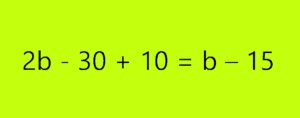
This is an equation with a single variable, the cost of the burger- “b”. Yes, you could have used any other letter, word, or even a picture instead, where the highest power of “b” is 1, thus a linear equation.
Solving linear equations
Solving linear equations is about determining the value of the variables that satisfy the conditions (or assumptions) presented. (For instance, if we consider the example concerning Tom’s age from the list above, we may be asked to solve for his age based under the condition, or assumption, that his father is 50 years old).
Linear equations come in varying complexities but in general, students will have to go through the two processes:
1. Isolating variables.
2. Substituting (or applying) conditions (or assumptions), or, replacing the variable with the value we are assuming it has.
Let’s go back to our burgers scenario. To start, it’s always good to see if you can simplify the expressions on the right-hand side or the left-hand side of the equation.
Step 1: On the left-hand side we can simplify -30 + 10, which gives -20. The simplified version would be:
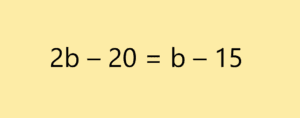
Step 2: Isolate b on the left-hand side of the equation
Solving this linear equation would be finding the value of “b”, which is the price of the burger. So, the goal is to get all terms of “b” to one side of the equation. Just like with a balance scale, you want to get the unknown item on one scale and the standard weights on the other, and ensure they are in the balanced position. Every change done to isolate the desired variable has to be made to both sides of the equation to sustain balance/ equality.
Here we should try and get rid of -20 from the left-hand side. To eliminate -20, I need to perform the inverse operation on it, which is to add 20.
1. Add 20 to both sides to balance:
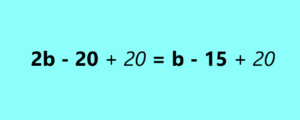
2. By simplifying we get: 2b = b + 5
3. Now, all we need to do is get the “b” term on the right side to the left side. Here too we can use the inverse.
Subtract b from both sides to balance.
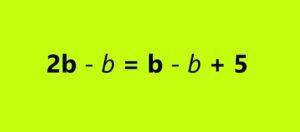
4. By simplifying we get: b = 5
There we go, the price of a burger is $5.
Linear equations with two variables
What if instead of buying a burger on the second day you bought a cup of coffee? The equation would now render as:
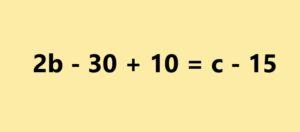
We have two variables here, “b” the price of a burger, and “c” the price of coffee.
Step 1: By following the steps of isolation and simplification we will end up with the following equation:
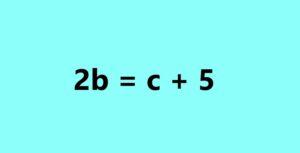
Step 2: To solve the equation we would need to know the value of at least one of the two variables. If “c” was known to be $3, then we can replace c with 3 in the equation
Step 3: Substitution (In this case we assume that c=3, so we substitute it with that).
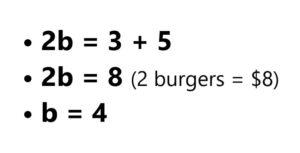
Hence the price of a burger would be $4 under the “condition” that the price of a coffee cup is $3.
What would it have been if the price of a coffee cup was $7? Try that equation on your own.
Real-life applications of linear equations
Problems that we come across on a day-to-day basis come in all shapes and forms. There are a large number of variables involved. Imagine we wanted to work out the battery life of a smartphone at a given time. How many variables could you come up with that would affect this? The number of installed apps, processor type, screen time of the user, and which apps are used more often are just a few of them.
However, many applications of these equations are modeled as linear equations having under 2 variables, a few of them are:
● Energy bill calculation: The variable here is the units of energy you’ve used and the cost per unit charged by your supplier
● Converting Fahrenheit to Celsius
● How much your Uber or Lyft charges you: Variables would be the distance you traveled, and time spent
● Banks use linear equations to calculate the interest you get for your deposits. Could you think of the two variables in this scenario?
Linear equations are essentially your doorway into advanced problem-solving techniques.
Can you think of other ways you could use linear equations in your daily life? Mention an example in the comments below.











Maybe trying to figure out who is using the most water in an apartment complex. The variables are the people using the water, the time period the bill is for, and the amount the water company charges per gallon.